Note
Go to the end to download the full example code.
Discrete functional decoding
Perform meta-analytic functional decoding on regions of interest.
We can use the methods in nimare.decode.discrete to apply functional
characterization analysis to regions of interest or subsets of a Studyset.
import os

import nibabel as nib
import numpy as np
from nilearn.plotting import plot_roi

from nimare.decode import discrete
from nimare.nimads import Studyset
from nimare.utils import get_resource_path
Load Studyset with abstracts
studyset = Studyset(
    os.path.join(get_resource_path(), "neurosynth_laird_studyset.json"),
    target="mni152_2mm",
)
studyset.annotations_df.head(5)
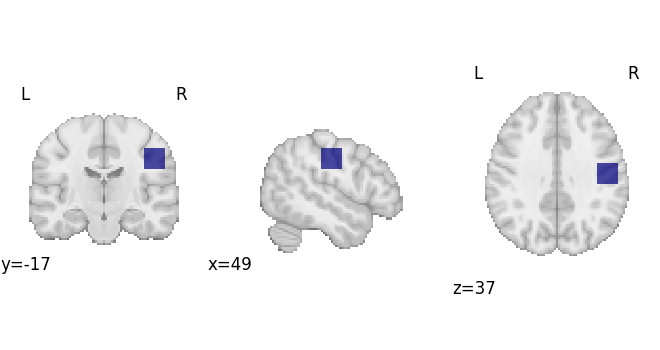
Create a region of interest
# First we'll make an ROI
arr = np.zeros(studyset.masker.mask_img.shape, np.int32)
arr[65:75, 50:60, 50:60] = 1
mask_img = nib.Nifti1Image(arr, studyset.masker.mask_img.affine)
plot_roi(mask_img, draw_cross=False)

# Get studies with voxels in the mask
ids = studyset.get_studies_by_mask(mask_img)
Decode an ROI image using the BrainMap method
# Run the decoder
decoder = discrete.BrainMapDecoder(correction=None)
decoder.fit(studyset)
decoded_df = decoder.transform(ids=ids)
decoded_df.sort_values(by="probReverse", ascending=False).head()
Decode an ROI image using the Neurosynth chi-square method
# Run the decoder
decoder = discrete.NeurosynthDecoder(correction=None)
decoder.fit(studyset)
decoded_df = decoder.transform(ids=ids)
decoded_df.sort_values(by="probReverse", ascending=False).head()
Decode an ROI image using the Neurosynth ROI association method
# This method decodes the ROI image directly, rather than comparing subsets of the Studyset like
# the other two.
decoder = discrete.ROIAssociationDecoder(mask_img)
decoder.fit(studyset)

# The `transform` method doesn't take any parameters.
decoded_df = decoder.transform()

decoded_df.sort_values(by="r", ascending=False).head()
Total running time of the script: (0 minutes 15.942 seconds)